

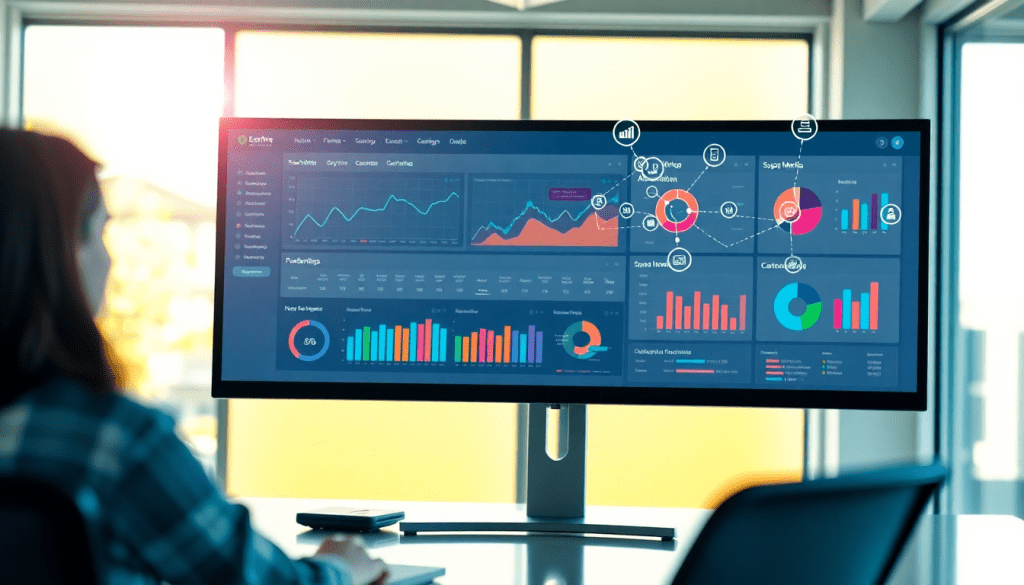
Multi-Channel Analytics Dashboard: Unified Marketing Insights
The complexity of modern marketing means data pours in from dozens of platforms—search, social, email, display, and more. But meaningful insight only comes when you can unify all those streams into a single, actionable view. A multi-channel analytics dashboard makes this possible, giving marketers a powerful tool to track, visualize, and optimize performance across every channel. Here’s how unified dashboards like TapClicks transform fragmented reporting into clear, automated marketing intelligence.
What Is a Multi-Channel Analytics Dashboard?
A multi-channel analytics dashboard gives marketers a single source of truth for all campaign data—no more toggling between tools or piecing together spreadsheets. Instead, it brings together performance metrics from every channel (search, social, email, programmatic, and more) into one unified, interactive view.
Why Modern Marketers Need a Unified Dashboard
Managing campaigns today means juggling data from:
- Google Ads & Search Engines
- Social Media Platforms (Facebook, Instagram, LinkedIn, etc.)
- Email Marketing Tools
- Programmatic Ad Platforms
- Display & Video Networks
Each system speaks its own language, tracks unique metrics, and lives in a separate silo. This makes it tough to answer questions like:
- Which channels are driving the most conversions?
- Where should we allocate next month’s spend?
- How do last week’s campaigns compare across platforms?
What a Multi-Channel Dashboard Solves
By consolidating your channels into one dashboard, you get:
- Holistic Performance Tracking: See every campaign, every metric, and every channel at a glance.
- Side-by-Side Comparisons: Instantly compare spend, clicks, conversions, and ROI across platforms.
- Customizable Visualizations: Build real-time charts that highlight trends, spot anomalies, and surface new opportunities.
- Automated Workflows: Replace hours of manual reporting with scheduled, accurate updates.
- Actionable Insights: Uncover what’s working—and what’s not—so teams can pivot fast.
The TapClicks Advantage
With TapClicks, you can:
| Feature | Benefit |
|---|---|
| 10,000+ Data Connectors | Integrate every marketing channel easily |
| Drag-and-Drop Dashboards | Custom views for clients & campaigns |
| Automated Reporting | Save hours weekly, reduce human error |
| Smart, AI-Driven Insights | Instantly spot optimization opportunities |
Why It Matters for Agencies and Brands
Having a multi-channel analytics dashboard isn’t just a “nice-to-have”—it’s your competitive edge. As covered in our marketing dashboard automation and agency efficiency article:
- Teams move beyond manual reporting to focus on strategy and growth.
- Faster, more accurate insights lead to better campaign optimization.
- Efficiency gains let you serve more clients (or locations) without adding headcount.
Bottom Line:
In today’s data-driven world, a unified dashboard is essential for smart, scalable marketing. If your teams are still wrangling spreadsheets, it’s time to level up—and let TapClicks do the heavy lifting.
Key Features of a Unified Reporting Platform
A truly unified reporting platform goes far beyond basic data collection—it brings every facet of your marketing performance into a single, powerful interface. Here are the must-have features that set leading platforms like TapClicks apart:
1. Seamless Data Aggregation
The foundation of any multi-channel analytics dashboard is robust data aggregation. With connections to thousands of marketing, advertising, and business platforms, a unified platform eliminates manual data pulls and messy spreadsheets. TapClicks, for example, offers over 10,000 data connectors, enabling you to extract, transform, and load (ETL/ELT) campaign data from virtually any source. This automated integration ensures your reporting is always up to date and comprehensive.
2. Cross-Channel Marketing Analytics
Siloed reporting makes it nearly impossible to see how channels influence each other. Unified reporting platforms blend and normalize datasets, allowing marketers to analyze performance across paid search, social, email, display, and more—all in context. You get a holistic view of campaign health, audience engagement, and channel attribution, enabling smarter optimization decisions.
3. Customizable Visualization & Reporting
A performance tracking dashboard should do more than display data—it should make insights clear and actionable. Look for drag-and-drop dashboards, white-labeled client portals, and flexible reporting studios that let you tailor visualizations to different stakeholders. TapClicks empowers users to build branded, automated reports that illuminate key metrics, trends, and ROI for every campaign.
4. Automated Insights & Smart Recommendations
The best unified dashboards leverage AI to analyze massive datasets and surface actionable insights. Features like SmartEmail and AI Agents in TapClicks automatically summarize campaign performance, flag anomalies, and suggest optimization tactics. This automation saves analysts hours each week and ensures decision-makers never miss critical opportunities.
5. Centralized ROI Tracking
An ROI tracking dashboard consolidates spend, conversions, and revenue data, giving marketers a clear view of what’s driving business outcomes. With unified reporting, you can easily track budget pacing, attribution, and cross-channel impact, making it simple to prove marketing’s value and reallocate spend for maximum return.
6. Multi-Platform Reporting Flexibility
Modern marketing teams need the freedom to work within their preferred BI tools and workflows. Platforms like TapClicks not only provide a single source of truth for analytics and reporting but also offer the flexibility to pipe cleaned, enriched data into external tools like Tableau, Power BI, and Looker. This adaptability ensures your reporting infrastructure can scale and evolve with your business needs.
Unified reporting platforms deliver more than convenience—they empower marketers to move from fragmented, reactive reporting to connected, proactive marketing intelligence. To see how these features come together in practice, explore the capabilities of TapClicks as a leading solution for multi-platform reporting and integrated analytics.
How Integrated Marketing Metrics Drive Better Decisions
Integrated marketing metrics are the consolidated performance indicators that draw from all your channels—search, social, display, email, and beyond—into a coherent, unified view. Unlike isolated metrics that only tell part of the story, integrated metrics reveal the true impact of your cross-channel efforts. This holistic approach is critical because today’s customer journey is anything but linear: a prospect might see your brand on Instagram, click an ad on Google, then convert after an email follow-up. Siloed data can’t capture these interactions; integrated metrics can.
Unified dashboards, like those offered by TapClicks, transform raw data into actionable marketing intelligence reporting. Instead of toggling between spreadsheets and individual platform analytics, marketers get a single source of truth. This enables deeper analysis, such as understanding how paid search investments influence organic social traffic, or how display campaigns lift email engagement. By visualizing these relationships—say, through a campaign performance dashboard that overlays channel contributions, customer journeys, and conversions—you gain context that’s otherwise lost in fragmented reports.
For example, a marketing team using TapClicks might set up a dashboard to monitor cost-per-acquisition (CPA) across all channels, but also track how social media impressions correlate with branded search volume or website engagement. With customizable visualizations, it’s easy to spot patterns—like a spike in conversions following a multi-channel product launch or a drop in leads when a key campaign pauses. These insights aren’t just interesting; they’re actionable, guiding decisions on budget allocation, creative optimization, and channel mix.
Ultimately, integrated marketing metrics empower teams to move from gut-feel decisions to data-backed strategy. When every channel’s impact is visible and comparable, marketers can identify what’s working, double down on high-performing tactics, and quickly pivot when results stall. In a world where agility and accuracy are essential, unified dashboards provide the marketing intelligence needed to drive growth and outpace the competition. To see how this works in practice, explore more about TapClicks’ unified analytics capabilities at tapclicks.com.
Automated Marketing Insights: AI & Real-Time Analytics
In the face of ever-expanding data streams, the true value of a multi-channel analytics dashboard lies in its ability to not just aggregate information, but to synthesize it into timely, actionable insights. This is where AI-powered automation fundamentally changes the game for marketing teams.
Modern platforms like TapClicks leverage artificial intelligence to analyze vast, cross-channel datasets automatically, surfacing trends, anomalies, and opportunities that might otherwise go unnoticed. Instead of wrestling with raw spreadsheets or manually building pivot tables, marketers receive real-time alerts, visualizations, and recommendations that drive smarter decisions—often before competitors can react.
One of the most compelling advantages of AI-driven dashboards is the speed at which insights are delivered. As detailed in this article on AI tools for marketing dashboards, automation eliminates lag time between campaign activity and reporting. With features like TapClicks’ SmartPilot and SmartEmail, insights are proactively generated and delivered to stakeholders, enabling teams to pivot strategies instantly or double down on what’s working.
The benefits go beyond time savings—though those are significant. AI automates repetitive analytics tasks, freeing analysts to focus on strategic work and reducing reporting workloads by dozens of hours each month. More importantly, it empowers organizations to move from reactive to proactive marketing: identifying performance shifts as they happen, predicting outcomes, and continuously optimizing spend for the highest ROI.
With real-time analytics and automated intelligence at their fingertips, marketers can finally transform data overload into a competitive advantage. To learn more about how TapClicks brings these capabilities together, visit TapClicks.
From Siloed Data to Omnichannel Analytics Solutions
The journey from siloed, single-channel reporting to true omnichannel analytics marks a critical evolution for modern marketing teams. Traditionally, marketers managed separate dashboards or spreadsheets for each channel—search, social, email, programmatic, and more. This approach not only made it difficult to compare performance across platforms, but also left teams vulnerable to blind spots, duplication, and missed insights. The result? Fragmented data streams that hindered holistic strategy, slowed reporting cycles, and increased the risk of costly errors.
Omnichannel analytics solutions, like those powered by TapClicks, address these challenges head-on by unifying paid, owned, and earned media data in one centralized platform. Instead of piecing together Google Ads reports with Facebook Insights or juggling third-party attribution tools, marketers can instantly view campaign performance, audience engagement, and spend across every channel—all in a single, customizable dashboard.
The key to this transformation lies in robust data consolidation and normalization. Leading platforms aggregate data from a vast range of sources, then clean and standardize metrics, so impressions, clicks, conversions, and spend are aligned across networks and vendors. This normalization empowers marketers to track true cross-channel KPIs, eliminate double-counting, and surface actionable trends—like how paid search is influencing organic traffic, or how social campaigns are amplifying earned media reach.
To get the most out of omnichannel analytics, best practices include:
- Inventory all data sources: Map every channel, platform, and data provider you use, from ad networks to CRM systems.
- Automate data integration: Use connectors and ETL tools to pull in data automatically, reducing manual effort and error.
- Standardize naming conventions and metrics: Ensure consistency in campaign names, UTM parameters, and conversion events.
- Centralize reporting: Build dashboards that blend data across channels, rather than relying on disparate, channel-specific views.
- Iterate and optimize: Continuously refine your data mapping and visualization to reflect evolving marketing strategies and goals.
Making this transition isn’t just about efficiency—it’s about unlocking a deeper, more strategic understanding of your marketing ecosystem. By consolidating and normalizing disparate data sources, omnichannel analytics solutions like TapClicks empower marketers to shift from reactive reporting to proactive, insight-driven decision making.
ROI Tracking Dashboard: Measuring What Matters
One of the biggest challenges in marketing is proving the real impact of your efforts. With campaigns running across search, social, programmatic, and more, calculating return on investment (ROI) can quickly become overwhelming—especially when data is scattered across multiple tools. A unified dashboard changes the game by centralizing all your performance data, making ROI measurement accurate, transparent, and actionable.
With a multi-channel analytics dashboard, marketers can track spend, conversions, and revenue side by side, enabling true apples-to-apples comparisons across every channel. This holistic view eliminates blind spots and the manual work of piecing together spreadsheets. The dashboard automatically pulls in data, applies consistent attribution models, and visualizes key performance indicators (KPIs) such as cost per acquisition (CPA), return on ad spend (ROAS), and customer lifetime value (LTV). Marketers and stakeholders get a clear picture of which campaigns drive the most value and where budgets should be optimized.
Attribution is another area where a unified dashboard excels. Instead of relying on last-click models that undervalue upper-funnel activities, modern platforms can support multi-touch attribution, giving credit to every channel that contributes to a conversion. This leads to smarter budget pacing and more strategic decision-making, as teams can see exactly how each effort impacts the bottom line.
For a closer look at how a digital marketing KPI dashboard can visualize metrics and ROI fast, consider how TapClicks empowers users with customizable dashboards that automate reporting and streamline performance tracking. By consolidating diverse data streams, TapClicks enables agencies, brands, and enterprise teams to move past surface-level metrics and focus on what matters most: measurable, provable marketing impact.
Ultimately, an ROI tracking dashboard is more than a reporting tool—it's a strategic advantage. With real-time insights and clear visualization of marketing ROI, organizations can justify spend, optimize campaigns in-flight, and continuously improve outcomes. To explore how unified dashboards can transform your marketing analytics, visit TapClicks.
Why Choose TapClicks for Multi-Platform Reporting
What truly sets TapClicks apart in the crowded field of unified reporting platforms is its ability to combine scale, intelligence, and operational efficiency into one seamless omnichannel analytics solution. Designed for agencies, brands, and enterprise teams managing high volumes of marketing data, TapClicks goes beyond simple data aggregation—it delivers automated insights, actionable recommendations, and robust workflow automation, all tailored for modern marketing operations.
Scale That Meets Enterprise Demands
TapClicks is built to support thousands of dashboards, reports, and client accounts at once. This makes it uniquely positioned for agencies and media companies that must deliver consistent, branded analytics at scale, or for multi-location brands seeking a centralized view across diverse campaigns. Unlike lighter-weight competitors, TapClicks is architected for high-volume, multi-client, and multi-channel environments.
AI-Driven Insights, Not Just Dashboards
While many platforms stop at dashboard visualization, TapClicks leverages advanced AI capabilities to surface actionable insights from your marketing data. With features like SmartPilot, predictive models, and AI tools for marketing dashboards, TapClicks doesn’t just report results—it explains them, benchmarks performance, and suggests optimization steps. SmartEmail even delivers automated, AI-curated insight summaries directly to your team or clients, turning raw data into real business intelligence.
Workflow Automation for True Efficiency
TapClicks’ workflow modules, including TapOrders and TapWorkflow, streamline campaign management, order processing, and cross-team collaboration. This means agencies can onboard clients faster, brands can coordinate marketing ops more seamlessly, and enterprise teams can connect marketing data with sales, CRM, and finance systems. The result is a drastic reduction in manual tasks—often saving over 50 hours per analyst each month.
Use Cases Across the Marketing Ecosystem
- Agencies & Media Companies: Deliver unified cross-channel reporting to hundreds of clients, automate repetitive tasks, and provide higher-value insights.
- Brands: Consolidate data from every location or region, oversee marketing spend, and optimize performance across paid, owned, and earned media.
- Enterprise Teams: Use TapClicks as a central data hub, feeding normalized and enriched data into BI tools or existing analytics stacks.
In a landscape where fragmented tools slow progress and obscure the real story, TapClicks empowers marketers to see the big picture—and act on it—faster than ever before. If you’re searching for a unified reporting platform that’s built for scale, powered by AI, and designed for actionable marketing intelligence, TapClicks stands out as the clear choice.
Getting Started: Steps to Build Your Unified Analytics Dashboard
Launching a multi-channel analytics dashboard may seem daunting, but with a systematic approach, you can quickly move from scattered data to actionable insights. Here’s a practical, step-by-step guide to get you started:
1. Identify Your Key Data Sources
Begin by cataloging the marketing channels and platforms most relevant to your business objectives. This might include paid search (Google Ads), organic and paid social (Facebook, LinkedIn, Twitter), email platforms, display networks, and even offline sources. Prioritize sources that drive the majority of your spend or conversions.
2. Select a Unified Reporting Platform
Choose a platform that provides robust data integration and supports all your key sources. Solutions like TapClicks offer 10,000+ pre-built connectors, making it easy to bring in data from virtually any marketing or advertising channel. Look for options that automate data extraction, transformation, and loading (ETL/ELT), so you spend less time wrangling spreadsheets.
3. Define Your Core Metrics and KPIs
Work with your stakeholders to agree on the most important metrics—impressions, clicks, conversions, CPA, ROI, and others—that will be tracked across channels. This ensures your dashboard delivers clarity, not clutter. For guidance on rapid metric selection and visualization, reference how digital marketing KPI dashboards drive ROI.
4. Configure Dashboards and Visualizations
Use your platform’s dashboard studio to design intuitive, role-based dashboards. Leverage drag-and-drop builders to create visualizations that bring performance trends to life—think cross-channel comparison charts, funnel visualizations, and executive summary widgets. Custom branding and white-labeling can help align the dashboard with your agency or brand.
5. Automate Reporting and Scheduled Insights
Set up automated delivery of reports to internal teams or clients. With TapClicks, you can schedule daily, weekly, or monthly reports, and even utilize AI-powered features like SmartEmail to send curated insights directly to stakeholders. Automation saves hours on manual reporting and ensures everyone stays informed.
6. Integrate with Existing BI Tools and Workflows
If your organization uses business intelligence tools (such as Tableau, Power BI, or Looker), ensure your dashboard platform supports direct data exports or API integrations. This lets you feed harmonized marketing data into wider business analytics, supporting deeper insights and cross-functional collaboration.
7. Monitor, Optimize, and Evolve
Finally, treat your dashboard as a living asset. Regularly review performance, solicit user feedback, and adjust dashboards to reflect changing business priorities or new channels. Experiment with AI-driven insights and predictive analytics to uncover new opportunities for optimization.
By following these steps, marketers can move from fragmented spreadsheets to a single source of marketing truth—enabling faster, smarter decisions and driving better outcomes across every channel.
Start Automating Your Marketing Data Today!
No Credit Card Required.

