

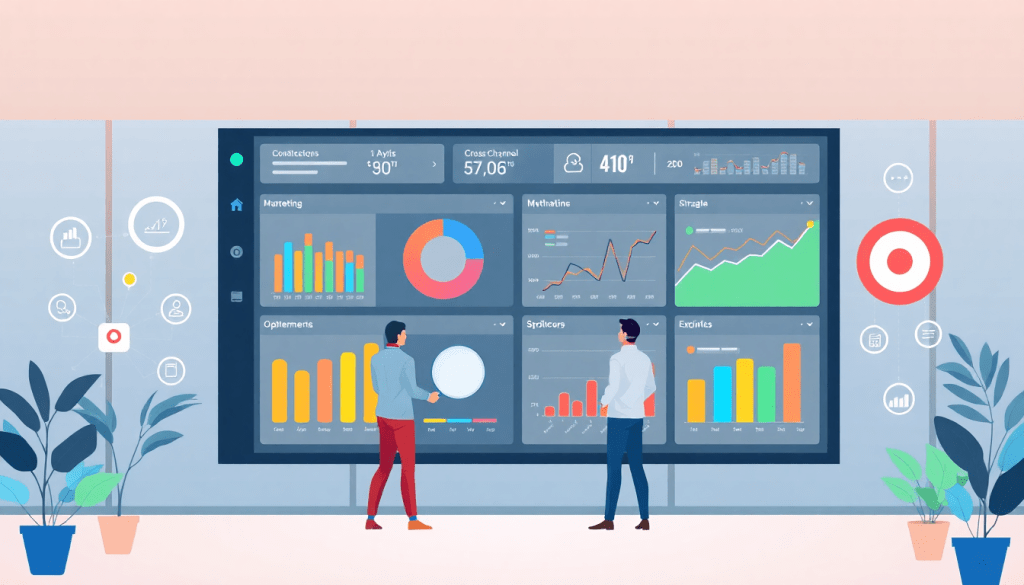
Digital Marketing KPI Dashboard: Metrics & Performance Insights
A digital marketing KPI dashboard puts your most important metrics front and center—helping marketers visualize campaign performance, track progress toward goals, and make smarter, data-driven decisions. With the right dashboard in place, teams can automate KPI reporting, uncover actionable insights, and demonstrate ROI across every channel. This guide explores how to choose, build, and optimize a performance tracking dashboard that empowers marketers, clients, and stakeholders with real-time analytics and clarity.
What is a Digital Marketing KPI Dashboard?
A digital marketing KPI dashboard is a centralized, real-time reporting tool designed to track, visualize, and analyze the key performance indicators (KPIs) that matter most to your marketing efforts. Its essential purpose is to give marketers, agencies, and brands a clear, at-a-glance understanding of campaign health and progress toward business goals—without the need to wrangle spreadsheets or manually compile reports.
Key features of a robust digital marketing KPI dashboard include:
- Real-time data integration: Seamlessly pulls in up-to-the-minute metrics from all your marketing channels—social media, search, display, email, and more—so you’re always working with the latest numbers.
- Multi-channel metrics: Aggregates performance data across platforms (Google Ads, Facebook, LinkedIn, programmatic, etc.), providing a unified view that eliminates data silos.
- Customizable visualizations: Lets users tailor dashboards with drag-and-drop widgets, charts, and branded themes to highlight the KPIs that align with their unique goals.
- Automated reporting: Schedules and delivers reports directly to stakeholders, saving hours of manual data collection and ensuring everyone stays informed.
- Role-based access: Offers permission controls so agencies, brands, and enterprise teams can securely share relevant data with clients, sales, or executive leadership.
Why are these dashboards so crucial for modern marketing teams? For agencies and media companies, a digital marketing KPI dashboard enables them to efficiently manage reporting for dozens—or even hundreds—of clients, boosting transparency and strengthening client relationships. Brands, especially those with multiple locations or complex campaigns, rely on dashboards to align internal teams, monitor performance in real time, and optimize spend across channels. Enterprise teams benefit from a single source of truth that powers both high-level strategy and granular optimization.
By automating KPI reporting and surfacing actionable insights, digital marketing dashboards empower all stakeholders to make smarter, data-driven decisions at scale. To see how automation transforms agency operations, explore this in-depth guide on marketing dashboard automation for agencies.
Benefits of Marketing Metrics Visualization
Transforming streams of raw data into clear, actionable visuals is at the heart of effective digital marketing management. Visualizing KPIs on a marketing dashboard simplifies even the most complex performance datasets, making it far easier for decision-makers to quickly grasp trends, spot anomalies, and identify opportunities. Instead of sifting through spreadsheets or disconnected reports, marketers and stakeholders can see at a glance which campaigns are thriving and where adjustments are needed.
One of the biggest advantages of KPI visualization is time savings. Automated dashboards like those offered by TapClicks pull in data from multiple channels in real time, eliminating manual data wrangling and reporting. Teams can access instant overviews of key metrics—impressions, conversions, spend, and more—freeing up hours previously spent on monthly or weekly report creation. This automation not only accelerates decision-making but also reduces the risk of errors, ensuring everyone is working from accurate, up-to-date information.
Effective visualization also drives better team alignment and client transparency. When all stakeholders have access to the same interactive dashboards, collaboration improves and conversations shift from “what happened?” to “what should we do next?” This shared visibility is essential for agencies managing multiple clients, as well as for brands running omnichannel campaigns across large organizations.
The impact on campaign optimization is equally significant. Data visualizations make it easy to spot underperforming channels, budget inefficiencies, or emerging market trends. With visual cues and automated insights, marketers can drill down into specifics and pivot strategies proactively rather than reactively.
TapClicks stands out as a leader in this space by offering advanced marketing data analytics tools designed to streamline KPI visualization, automate reporting, and empower marketers with the clarity needed for continual growth. By putting the right data in the right format at the right time, marketing KPI dashboards transform how teams optimize campaigns, demonstrate value, and achieve results.
Core Metrics to Track in Your Performance Dashboard
A high-impact digital marketing KPI dashboard is only as valuable as the metrics it surfaces. To truly drive performance, your dashboard should spotlight the KPIs that map directly to your goals, campaigns, and channels. Here’s a breakdown of the essential metrics every marketing team should consider:
1. Impressions and Reach
These foundational awareness metrics show how many times your ads or content were displayed (impressions) and how many unique users saw them (reach). Tracking both helps gauge the scale and frequency of your campaigns.
2. Clicks and Click-Through Rate (CTR)
Clicks indicate initial engagement, while CTR (calculated as clicks divided by impressions) measures the effectiveness of your creative and targeting. High CTRs often signal that your messaging resonates with your audience.
3. Conversions and Conversion Rate
Conversion metrics capture the ultimate goal—whether it’s a purchase, form submission, download, or other desired actions. Conversion rate reveals how efficiently your campaigns move prospects down the funnel.
4. Cost Per Acquisition (CPA)
CPA tracks the average spend required to acquire a single customer or lead. This KPI is critical for budget allocation, as it ties financial efficiency directly to campaign outcomes.
5. Return on Ad Spend (ROAS)
ROAS measures revenue generated for every dollar spent on advertising. By calculating ROAS, marketers can identify the most profitable channels and campaigns, allowing for smarter optimization.
6. Engagement Metrics
Beyond basic clicks, engagement scores capture user interactions—likes, shares, comments, video views, and more. These metrics are especially valuable for measuring the impact of content and social media strategies.
7. Attribution and Assisted Conversions
Complex buyer journeys demand more sophisticated tracking. Attribution metrics show which channels and touchpoints contribute to conversions, helping teams understand true campaign influence and optimize spend accordingly.
8. Budget Pacing and Spend
Real-time budget tracking ensures you’re not overspending or underdelivering. Budget pacing dashboards allow marketers to adjust strategies on the fly and avoid costly surprises at month-end.
Custom & Advanced Metrics
Every business is unique. Custom metrics—such as lead quality scores, lifetime value, or location-based performance—let teams tailor dashboards to their specific objectives and verticals. Advanced dashboards may also include predictive models or anomaly detection for proactive optimization.
By integrating these metrics into a unified dashboard, marketers gain both a holistic overview and the ability to drill down into granular performance drivers. Platforms like TapClicks make it easy to blend, customize, and visualize KPIs from across your entire marketing stack, ensuring your dashboard always aligns with your most important business goals.
Cross-Channel Analytics: Unifying Data for True Insights
In today’s fragmented digital landscape, marketing success depends on orchestrating campaigns across a spectrum of paid, owned, and earned channels. A cross-channel analytics dashboard brings all these moving pieces together—aggregating performance data from sources like Google Ads, Facebook, programmatic display, email, organic social, SEO, and even offline media—into a single, cohesive view. This unified approach enables marketers to track not just individual channel performance, but the broader impact of their entire marketing mix.
The power of blended reporting lies in its ability to illuminate the relationships between channels. For example, you can easily connect the dots between paid social impressions and website conversions, or analyze how organic content boosts overall engagement and supports retargeting efforts. With true cross-channel analytics, teams can spot trends, optimize budget allocation, and attribute results accurately—fueling more informed decisions and better campaign outcomes.
However, unifying disparate data streams isn’t without challenges. Data silos, inconsistent metrics, and manual reporting can quickly bog down even the most sophisticated marketing teams. That’s where TapClicks stands apart. TapClicks’ platform integrates with over 10,000 marketing, advertising, and business data sources, automates the ETL process, and normalizes metrics across every channel. This means agencies, brands, and media companies can break free from spreadsheets and fragmented dashboards, and instead rely on real-time, blended performance insights that drive strategy forward. By centralizing data and analytics, TapClicks not only eliminates silos but empowers marketers to unlock the full value of their omnichannel efforts.
Free Yourself from Manual Reporting
Manual KPI reporting is a notorious time sink. Copying metrics from channel after channel, cross-checking for errors, building PowerPoints—this old-school approach drains resources and slows down your ability to act on data. Enter automated KPI reporting and campaign monitoring: a smarter, faster way to keep your finger on the pulse.
Why Automate Your Reports?
Here’s what you gain when you switch from manual to automated KPI dashboards:
- Seamless Data Integration: Connect all your marketing, ad, and analytics sources—no more chasing down spreadsheets.
- Real-Time or Scheduled Updates: Reports refresh on your schedule (or instantly), so you always have up-to-date numbers.
- Reduced Human Error: Automate the data pipeline and say goodbye to copy-paste mistakes.
- Strategic Focus: Free up your team to analyze, optimize, and collaborate—instead of wrangling data.
How TapClicks Makes Campaign Monitoring Effortless
TapClicks automates and elevates KPI tracking with features built for busy marketing ops and analytics teams:
- Automated Alerts & Thresholds
- Set up instant notifications: Get alerted if key metrics (like CPA, CTR, or budget pacing) move outside your target range.
- Proactive, not reactive: Address issues before they spiral.
- Scheduled Reporting
- Automate delivery of reports—daily, weekly, monthly—to all stakeholders.
- No more manual follow-ups or version confusion.
- Visual Trend & Anomaly Detection
- Spot performance surges or dips at a glance with intuitive dashboards.
- Drill down into root causes quickly, so you can optimize in real time.
Pro Tip: Automate Smarter, Not Harder
Before you dive in, check these boxes:
- Identify your most critical KPIs (don’t track everything—track what matters)
- Connect all relevant data sources to your dashboard platform
- Set up thresholds and alerts for must-watch metrics
- Schedule regular report deliveries to the right people
- Review dashboards at least weekly for trends and anomalies
Transform Reporting from Reactive to Proactive
When you automate KPI reporting and campaign monitoring, you move from static, after-the-fact measurement to always-on optimization. The result? Faster insights, better campaign outcomes, and more time for creative strategy.
Ready to take the next step? Check out this guide to dashboard automation and reporting with TapClicks. Unlock the power of real-time reporting—and watch your marketing performance soar.
How AI Is Transforming Marketing Dashboards
Artificial intelligence is changing the game for marketers—turning traditional dashboards from passive metric displays into living, insight-driven tools. With AI in the mix, your dashboard isn’t just reporting what happened; it’s helping you understand why, what to do next, and how to stay ahead of the competition.
What Sets AI-Powered Dashboards Apart?
AI-driven dashboards bring several key advantages to the table:
-
Automated Insight Discovery:
Instantly surface trends, anomalies, and opportunities hidden in cross-channel data—no manual digging required. -
Industry Benchmarking:
See at a glance how your campaigns stack up against historical results or industry peers, so you can set smarter, more ambitious goals. -
Predictive Analytics:
Go beyond “what happened” to “what’s likely to happen,” with AI models forecasting future performance and budget needs.
TapClicks in Action: Smarter, Faster Decisions
TapClicks takes performance tracking to the next level with AI features like:
| Feature | What It Does | Why It Matters |
|---|---|---|
| Smart Insights | Scans all your marketing data for actionable recommendations (e.g., flagging underperformers, spending spikes, or optimization opportunities) | Cuts through noise—so you focus on what moves the needle. |
| SmartEmail | Automatically sends AI-curated campaign summaries straight to your inbox or a client’s | Keeps everyone informed and agile, without manual report prep. |
| AI Agents | Proactively monitor dashboards, alerting you to anomalies or emerging trends | You never miss critical changes—AI has your back. |
Interactive Exploration: From Reporting to Real-Time Discovery
Modern dashboards aren’t just for viewing—they’re for exploring. With TapClicks, you can:
- Drill down into any KPI or segment in real time
- Apply custom filters by channel, audience, or campaign
- Instantly answer follow-up questions for clients or stakeholders
This hands-on approach means you’re not waiting for the next report—you’re always a click away from the “why” behind your numbers.
Why It Matters for Marketers and Agencies
- Faster Time-to-Insight: Spend less time sifting through data, more time acting on insights.
- Client-Ready Intelligence: Deliver clear, concise, and actionable updates—automatically.
- Continuous Optimization: Proactively improve campaigns, rather than reactively fixing problems.
Harnessing AI and interactive dashboards with TapClicks turns marketing performance tracking into a real-time, collaborative, and predictive process—giving your team the edge to win in today’s data-driven landscape.
Proving ROI: From Data Visualization to Actionable Insights
A digital marketing KPI dashboard is more than just a collection of charts—it’s a strategic engine for proving and improving ROI. To unlock its full value, marketers must move through a disciplined process: visualize, analyze, optimize, and communicate.
The journey begins with robust data visualization. By mapping key performance indicators (KPIs) across campaigns, channels, and audiences, dashboards distill complex datasets into clear, digestible visuals. This clarity enables marketing teams and stakeholders to spot trends, identify outliers, and understand the real-time impact of their investments—without sifting through endless spreadsheets.
But visualization alone isn’t enough. The next step is analysis: digging into the data to surface actionable insights. An effective dashboard empowers users to compare KPIs side-by-side, segment results by audience or region, and drill down into the drivers behind performance shifts. With these capabilities, marketers can uncover what’s working, what’s not, and why.
Optimization naturally follows. Armed with insights, teams can adjust creative, reallocate budgets, or refine targeting strategies—all with the confidence that they’re making data-driven decisions. Real-time dashboards also facilitate agile optimization, allowing teams to pivot quickly and capitalize on opportunities as they emerge.
Crucially, a KPI dashboard streamlines communication of ROI to clients and executives. With automated, branded reporting and visual storytelling, marketers can clearly illustrate the bottom-line results of their efforts. Instead of defending spend with raw data dumps, they can showcase meaningful outcomes—such as cost per acquisition (CPA) reductions, return on ad spend (ROAS) improvements, or increased conversion rates—backed by transparent, trustworthy analytics.
Platforms like TapClicks are purpose-built to make this ROI lifecycle seamless. TapClicks unifies data from thousands of sources, automates report generation, and leverages AI to highlight key insights and optimization opportunities. For agencies and marketing teams, this means less time wrangling data and more time demonstrating value—turning dashboards into a powerful tool for both accountability and growth.
Choosing the Right Digital Campaign Reporting Platform
Selecting a digital campaign reporting platform is a crucial decision that shapes how your marketing team operates, collaborates, and demonstrates value. To ensure your dashboard solution stands the test of time—and scales with your growth—prioritize these must-have criteria:
1. Scalability & Performance
Your reporting platform should seamlessly handle increasing data volume and user count, whether you're supporting a handful of campaigns or thousands across multiple clients. TapClicks, for example, is purpose-built for high-volume agencies and enterprises, managing massive data sets and dashboards without compromising speed or reliability.
2. Integration Ecosystem
The ability to unify data from all your marketing channels is non-negotiable. Look for robust, native integrations with advertising, analytics, CRM, and business platforms. TapClicks offers over 10,000 connectors, making it simple to blend paid, owned, and earned data for holistic cross-channel reporting. In contrast, alternatives like Funnel.io and Supermetrics primarily focus on data piping, often requiring additional tools for dashboarding and analysis.
3. Customization & Visualization
Every organization has unique KPIs and reporting needs. Choose a platform with flexible, drag-and-drop dashboard builders, customizable templates, and advanced visualization options. TapClicks excels here, letting users tailor dashboards for different clients, campaigns, and executive views—while competitors like Agency Analytics and NinjaCat tend to offer more rigid, out-of-the-box solutions.
4. User Access Control & Collaboration
Role-based access, white-labeling, and granular permissions are key for agencies, media companies, and brands managing sensitive data or multiple stakeholders. Platforms like TapClicks provide advanced access control, supporting effortless collaboration between sales, ops, and fulfillment teams. Datorama (Salesforce) offers similar sophistication, but often at a higher cost and with a steeper learning curve.
5. AI & Automated Insights
Modern marketing dashboards should do more than just display data—they should help you interpret it. TapClicks’ built-in AI agents and Smart Insights deliver automated recommendations, anomaly detection, and predictive forecasting. While some competitors are adding AI features, TapClicks leads with actionable, campaign-level insights and automated report summaries.
6. Onboarding & Support
Switching platforms can be daunting. Prioritize vendors that offer hands-on onboarding, migration support, and ongoing training for your team and clients. Effective onboarding ensures you unlock the full potential of your dashboard investment and drive faster adoption.
Platform Comparison at a Glance
| Platform | Strengths | Limitations |
|---|---|---|
| TapClicks | Unified scale, AI, workflow | Advanced features may exceed needs for very small teams |
| Funnel.io | Data integration | Requires add-ons for dashboards |
| Datorama | Deep customization | Complex setup, high cost |
| Agency Analytics | Simplicity, affordability | Limited scalability, integrations |
| NinjaCat | Easy reporting | Lighter analytics, fewer connectors |
Getting Started: Tips for Onboarding Teams and Clients
- Start with core KPIs and gradually build more complex dashboards as users grow comfortable.
- Leverage vendor training resources—TapClicks, for instance, provides onboarding specialists and a comprehensive knowledge base.
- Pilot with a small group before full rollout, collecting feedback to refine templates and workflows.
- Communicate the value—show how automated dashboards save time, improve accuracy, and empower smarter decisions.
Choosing a platform like TapClicks gives you the flexibility, power, and future-ready features to visualize, automate, and optimize your marketing performance at scale—ensuring your dashboards work for your team, not the other way around.
Start Automating Your Marketing Data Today!
No Credit Card Required.

